


Not the first time I’ve hit on this topic, but felt it worth revisiting in a new format. As I have previously written on the social media-youth mental health moral panics, I thought to just rant a bit and see what comes of it—no edits, no notes, no re-takes… Click on the title below for a critique I wrote in November 2025.
What do The Anxious Generation and the Last Child in the Woods have in common?:
The short answer to that question is the subtitle of that same Substack piece: Pathologizing Childhood to Sell Books.
Here I argue that the popular “kids and screens” moral panic has been oversimplified, especially in relation to Jonathan Haidt’s The Anxious Generation. The evidence is often correlational rather than causal, so social media and smartphones may be linked to youth distress without necessarily causing it, and I, among others, caution against turning a complex mental-health issue into a one-factor blame/villain story.
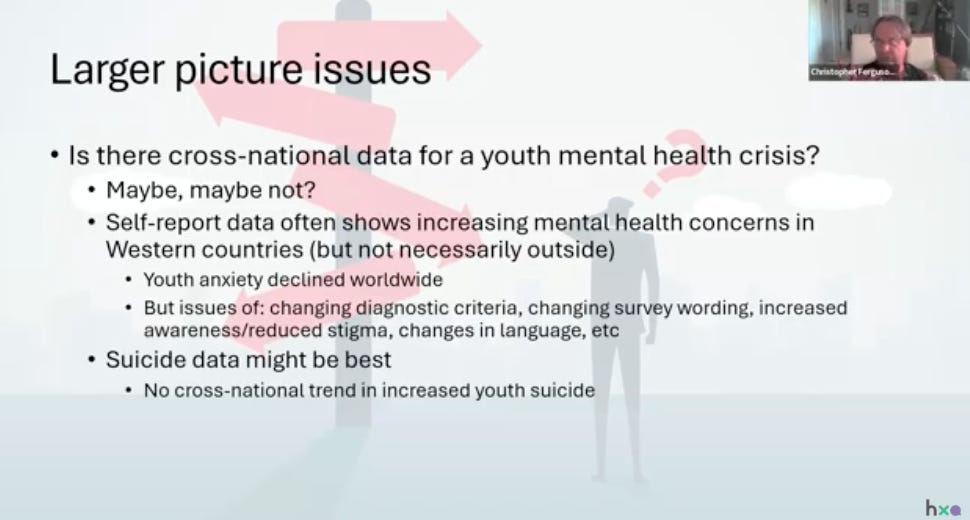
A recent lecture from psychologist and researcher Dr. Chris Ferguson (see his presentation slide above), easily found HERE on Youtube, suggest there is as much evidence of a youth mental health crisis as there is for an absence of one. It’s just not that clear. Equally, he points out that the results from studies of social media/screen use on youth mental health are hard to interpret, whether good or bad, due to the ‘noise’ of changing measures, self-reports from kids who are now more likely to use patholgizing language (and self-diagnosing/identifying that Dr. Will Dobud and I rally against in KIDS THESE DAYS), .
The evidence is often correlational rather than causal, so social media and smartphones may be linked to youth distress without necessarily causing it, and I, among others, caution against turning a complex mental-health issue into a one-factor blame/villain story. Chris (above) also found studies showing positive effects of youth interacting with social media—of course! But the common narrative, on social and mainstream media, suggest screen time is a bad thing, full stop.
Some simple ‘take aways’
-Remember that youth mental health is a complex “wicked” problem that cannot be explained by one villain, such as smartphones or social media.
-Think critically about how influencers, media, and policymakers may present correlational findings as causal, and then use that simplified narrative to justify interventions such as device bans in schools.
-Be skeptical about headline-driven research claims, and ask questions like who funded a study, whether it was replicated, and whether it actually tested for cause. Even, who benefits from the claims? Is someone profiting from the response to the claims?
-And consider that research on school phone bans is now debated as to the overall ‘effect.’ We, the Adults in the room, may have created new problems, such as weaker relationships, increased behavioural issues, or stronger device use outside school hours.
Did I over-reach?
I do compare ADD/ADHD medication to device bans in schools as behavioural control measures in this short rant. Let me know your thoughts on that rationale—that was a new thought for me. Yikes. Again, this unscripted monologue was an experiment. Did it work? What can I do to improve? Talk less? Actually use notes to be more to the point…?


